AMSTERDAM, Sept. 23, 2026 /PRNewswire/ -- Sungrow, a globally leading PV inverter and energy storage system provider, has brought its all-in-one residential energy storage system to its first European markets. PowerHarbor, which made its debut at Intersolar Europe 2026, is now available in the Netherlands, Belgium, and Luxembourg.
As net metering in the Netherlands is set to end on January 1, 2027, households with rooftop solar have reason to rethink how they use the electricity they generate. For homeowners considering storage, the key questions are practical: how will it work with their existing solar system, how much space will it need, and how easily can it be managed?
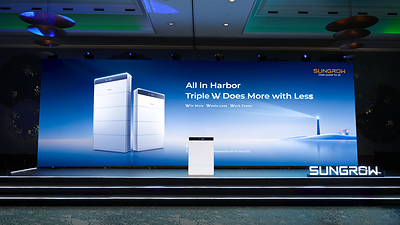
PowerHarbor is designed with these questions in mind. Under the theme "All in Harbor", it brings the inverter, battery, backup and energy management together in one system. Built around the "Triple W" value proposition—Win More, Waste Less, Work Faster—it is designed to help households get more value from their solar energy while taking up less space, requiring fewer additional devices, and enabling faster installation.
Win More with High-Power, AI-Driven Energy Flow
Capturing the midday peak. Around midday, solar generation can peak while household demand remains low, and electricity prices can fall sharply—even below zero. Surplus generation may then be exported when its market value is low. On oversized PV arrays, output can also be clipped once generation exceeds the inverter's conversion capacity.
PowerHarbor is built to keep more of that energy within the home. Its up to 160% PV-to-battery charging capability allows the battery to absorb more solar generation during peak production periods, while its 0.66P discharge rate can release the full stored capacity in around 1.5 hours when household demand or energy value rises. Together with its VPP-optimized design, these capabilities enable PowerHarbor to respond flexibly to VPP dispatch needs while sustaining performance. PowerHarbor is already integrated with 28 VPP platforms across Europe, giving households more choice in VPP programs.
Choosing the right hours. On a dynamic contract, value comes down to timing: when to charge, when to hold and when to use energy. Few households can make these decisions hour by hour, and a fixed schedule set at commissioning cannot keep pace with a constantly changing market.
PowerHarbor comes standard with iHomeManager Mini, the industry's first Mini AI solution. Activated with a single tap, its AI Mode combines weather forecasts, household consumption patterns and electricity prices to help determine when energy should be stored, held or discharged. With Shelly integration, the approach can extend to connected appliances across the home.
Powering heavy loads on any phase. In a modern home, a heat pump, induction hob and EV charger can all run at once. On a three-phase connection, those loads rarely fall evenly. High demand on one phase can reach that phase's output limit, even when output headroom remains available on the other phases. PowerHarbor supports up to 150% three-phase unbalanced output,* giving households greater flexibility to run high-power appliances when needed while making better use of their own solar energy.
Waste Less with Flexible, Compact Design
With a large installed base of rooftop solar, retrofit is an important part of the Benelux residential market. For these homes, adding storage with PowerHarbor does not have to mean starting from scratch.
Where a home already has a working PV system, PowerHarbor can be deployed as separate inverter and battery units, adding storage without replacing existing equipment. Where an existing inverter is being swapped for the all-in-one system, startup voltage is a common consideration: a higher threshold may rule out shorter strings, which can mean adding panels or rewiring. PowerHarbor's 100 V startup voltage and wide MPPT range support more string layouts, so existing strings can often be retained, subject to voltage and current compatibility.
Built with high-energy-density 314 Ah cells, the unit is just 25.5 cm deep, so it fits narrow hallways and passageways. With 6, 9 and 10 kWh battery modules and 83 possible combinations within a single unit, the system's capacity can be configured flexibly. Because each module has its own built-in battery optimizer, new modules can later be added alongside existing ones, including modules of a different capacity, without replacing batteries that still hold value.
Work Faster with Plug-and-Play Installation
PowerHarbor's battery modules stack without external cables, with the blind-mate connection taking around 10 seconds per module. All external terminals sit on the right-hand side, matching how most installers work. PowerHarbor also pairs with EnergyBridge, the industry's first Mini backup solution, which integrates five functions into a single DIN-rail-mounted device. Up to 99% smaller by volume than a conventional gateway, the device fits inside a standard distribution box and installs in around 20 seconds with no wall damage. For energy management, iHomeManager Mini plugs in as standard, with no separate EMS control box to install.
As Benelux households adapt to a more dynamic energy landscape, Sungrow remains committed to making solar, storage and intelligent energy management easier to adopt—for households already generating their own power and for the installers helping them take the next step.
*Up to 150% three-phase unbalanced output applies to 10–12 kW models.
Media Contact:
Ava Liu
liuke4@sungrowpower.com
+86 15209833830
 View original content to download multimedia:https://www.prnewswire.co.uk/news-releases/all-in-harbor-sungrow-brings-powerharbor-to-benelux-homes-for-more-value-less-complexity-302887281.html

Mit einem Gottesdienst und einer Abschlusspressekonferenz endet an diesem Donnerstag in Fulda die Herbstvollversammlung der Deutschen Bischofskonferenz. Unter der Leitung ihres neuen Vorsitzenden, des Münsteraner Bischofs Heiner Wilmer, haben die katholischen Bischöfe seit Montag eine Vielzahl gesellschafts- und kirchenpolitischer Themen beraten. Auf der Agenda standen Fragen der demokratischen Kultur in Deutschland, die Aufarbeitung sexuellen Missbrauchs, ethische Konfliktfelder wie Leihmutterschaft sowie der Umgang mit neuer Technologie wie Künstlicher Intelligenz. Hinzu kamen innerkirchliche Schwerpunkte wie die Entwicklung der Erwachsenentaufen, die Mitwirkung von Laien und der Einsatz in sozialen Medien.
Deutlich positionierten sich die Bischöfe zum politischen Klima im Land. Wilmer warnte mit Blick auf eine mögliche Regierungsbeteiligung der AfD in Sachsen-Anhalt vor einem „Paradigmenwechsel“. Die Partei stelle die Grundwerte des gesellschaftlichen Zusammenlebens infrage und wolle „ein anderes Deutschland“, sagte der Vorsitzende zum Abschluss der Beratungen. Besonders kritisch sehen die Bischöfe, dass einige Positionen der AfD aus ihrer Sicht mit dem christlichen Glauben und dem zugrunde liegenden Gottes- und Menschenbild nicht vereinbar seien.
Der DBK-Vorsitzende stellte sich demonstrativ hinter den Magdeburger Bischof Gerhard Feige und das Bistum Magdeburg, vor allem mit Blick auf Spekulationen über mögliche Folgen einer AfD-geführten Landesregierung. Diskutiert wird in diesem Zusammenhang, ob etwa der Einzug der Kirchensteuer zur Disposition stehen könnte. Die Kirche müsse „mit allem rechnen“ und stelle sich so auf, „dass wenn große Erschütterungen kommen sollten, wir gewappnet sind“, betonte Wilmer. Es dürfe nicht sein, dass ein Bistum durch politische Weichenstellungen im Nachteil sei.
Die Bischöfe sehen sich zugleich mit einem Stimmungsumschwung in Teilen ihrer eigenen Basis konfrontiert. Nach Aussage Wilm ers ist es „erschreckend“, wenn rund 30 Prozent der Katholikinnen und Katholiken in Ostdeutschland die AfD wählen, die in Sachsen-Anhalt als gesichert rechtsextrem eingestuft ist. Als Antwort auf wachsenden Antisemitismus und gesellschaftliche Polarisierung verweist die Bischofskonferenz auf die jüdisch-christliche Tradition, auf Menschenwürde und Solidarität. Auftrag der Kirche sei es, mit den Menschen zu reden, ihnen zuzuhören und so den gesellschaftlichen Zusammenhalt zu stärken.
Neben der politischen Lage blieb die Kirche bei der Vollversammlung auch mit eigenen Reform- und Krisenthemen befasst. Die Bischöfe berieten über weitere Schritte bei der Aufarbeitung von sexuellem Missbrauch und diskutierten, wie Laien stärker an Entscheidungsprozessen beteiligt werden können. Zudem rückten neue Handlungsfelder in den Blick: Die wachsende Bedeutung von Social Media und der Einsatz Künstlicher Intelligenz in Pastoral und Verwaltung werfen für die Kirche Fragen nach Verantwortung, Transparenz und ethischen Leitplanken auf. Die Beschlüsse und Leitlinien der Konferenz sollen in den kommenden Monaten in den Diözesen konkretisiert werden.