HANGZHOU, China, Oct. 22, 2026 /PRNewswire/ -- Hikvision, a global leader in the AI-powered Internet of Things (AIoT), has launched Quick Pass, a comprehensive access control solution designed to simplify people and vehicle access management across residential and commercial environments. By bringing pedestrian and vehicle entry into one solution, it reduces complexity while delivering faster access, stronger security, and simpler day-to-day management.
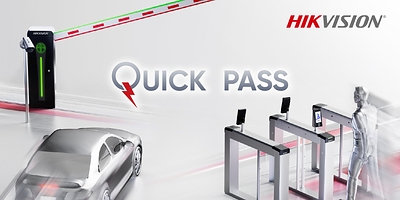
Designed for residential communities and commercial sites, Quick Pass combines intelligent access hardware with unified management software. It supports cloud-based and on-premises deployment, offering flexibility to meet different operational needs and accommodate future expansion.
One connected system for smoother passage and tighter security
Whether it is a residential community, office building, or factory, access control often creates unnecessary delays and extra work. Common issues include:
Quick Pass addresses these challenges through one platform. It supports multiple authentication methods for people, vehicles, and visitors, while centralizing permissions, visitor management, attendance, and access records. Hikvision's MinMoe terminals deliver facial recognition in less than 0.2 seconds with 99% accuracy, while ANPR cameras offer 98.5%+ license plate recognition precision. Together with automatic barrier control, these technologies help people and vehicles pass through entrances efficiently.
AI makes access management simpler and smarter
Quick Pass incorporates AI capabilities to improve both access recognition and management efficiency. AI enhances recognition performance to support reliable access verification, helping people and vehicles enter more smoothly.
AI-powered natural language interaction also makes access management more intuitive. Administrators can describe tasks in everyday language to manage user registration, visitor access, permissions, and attendance, reducing the effort required for routine operations.
"Access management should be easy to deploy, simple to manage, and flexible enough to meet the needs of different sites," said Wenson Zhou, Product Marketing Director at Hikvision. "With Quick Pass, we have combined people and vehicle access into one solution that reduces operational complexity while providing a faster, smoother, and more secure experience. By integrating AI into access management, we are also making entry smarter and helping administrators handle everyday tasks more efficiently."
Find out more
To learn more about the Quick Pass solution, please visit the Hikvision website.
 View original content to download multimedia:https://www.prnewswire.co.uk/news-releases/hikvision-launches-the-quick-pass-to-simplify-people-and-vehicle-access-control-302916828.html

Die Innenministerkonferenz (IMK) der Länder hat ihr seit 1954 praktiziertes Einstimmigkeitsprinzip aufgegeben und setzt künftig auf Mehrheitsentscheidungen. Beschlüsse gelten nun als gemeinsame Linie der Länder, wenn mindestens 13 der 16 Innenministerinnen und Innenminister zustimmen. Die Neuregelung wurde nach Angaben eines Sprechers des Gremiums im schriftlichen Umlaufverfahren beschlossen und gilt ab sofort.
Auslöser für den Kurswechsel ist die Möglichkeit, dass in kommenden Landesregierungen die AfD das Innenressort übernehmen könnte. In Sachsen-Anhalt hatte ihr Spitzenkandidat Ulrich Siegmund zuletzt erklärt, er wolle sich im Dezember zum Ministerpräsidenten wählen lassen – ein Schritt, der eine Regierungsbildung mit AfD-Beteiligung als realistische Option erscheinen lässt. Nach der bisherigen Praxis hätte ein Land mit einem AfD-Innenminister im Zweifel IMK-Beschlüsse blockieren können.
Mit der Abkehr von der Einstimmigkeit wollen die übrigen Länder nach übereinstimmenden Angaben verhindern, dass ein einzelnes Ressort – unabhängig von der parteipolitischen Farbe – zentrale Positionierungen in Fragen der inneren Sicherheit ausbremst. Bislang sollte die Einstimmigkeit sicherstellen, dass kein Land bei sensiblen Themen überstimmt wird; ein Veto oder auch eine Enthaltung konnten Beschlüsse stoppen, abweichende Positionen wurden im Protokoll dokumentiert. Künftig soll bereits eine breite, aber nicht mehr vollständige Zustimmung als ausreichend gelten, um einen länderübergreifenden Standpunkt zu formulieren.
Formal bleibt die IMK ein informelles Gremium ohne gesetzliche Grundlage. Sie ist weder im Grundgesetz noch in Bundes- oder Landesgesetzen verankert und verfügt über keine geschriebene Geschäftsordnung. Gleichwohl entfalten ihre Beschlüsse beträchtliche Wirkung, weil sie in den Ländern politisch aufgegriffen und umgesetzt werden. Mit der nun eingeführten Mehrheitsregel verschiebt sich das Machtgefüge innerhalb dieser Runde: Konsens bleibt möglich, ist aber nicht mehr Voraussetzung dafür, dass die Innenminister gemeinsam handeln.