Cision's 2026 State of the Media Report reveals 66% of journalists rely on PR for story ideas
CHICAGO, May 13, 2026 /PRNewswire/ -- Cision, a global leader in consumer and media intelligence, today released its 2026 State of the Media Report, revealing a shift in how the media ecosystem operates: PR is no longer just pitching stories, it's becoming a critical part of how the modern newsroom works.
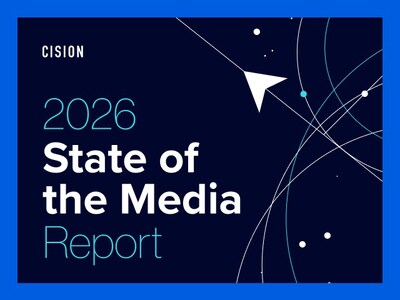
Based on a global survey of nearly 2,000 journalists across 19 markets, the report finds that 66% of journalists rely on PR-provided content – including press releases, pitches, and media kits – for story ideas, making PR the leading source of story leads.
More information. More pressure.
Journalists are working across a more fragmented media landscape, and competing with creators and AI for audience attention. At the same time, newsroom constraints continue to grow:
These trends point to a shift in how journalists and PR professionals work together, with journalists placing greater reliance on PR teams that can provide timely, relevant, and credible information.
"The 2026 report makes one thing clear: The newsroom and PR professionals are more interdependent than ever," said Amy Jones, Chief Marketing Officer at Cision. "As journalists face unprecedented pressure on their time and resources, PR is becoming an essential partner, providing data, ideas, and expert access that helps support the news cycle."
Key insights
What this means for PR
As AI becomes more embedded in newsrooms, generic outreach is losing impact.
Journalists are clear on what works: Relevant ideas, original research, credible data, expert access, and ready-to-use assets.
PR teams that support how journalists work, not just pitch them stories, are the ones that stand out.
In a faster, more fragmented media environment, clarity, and credibility, not volume, drive impact.
Download the 2026 State of the Media Report
Cision is following the report's release with a two-part webinar series featuring a panel of journalists who will unpack the findings and answer audience questions. Register for free
About the 2026 State of the Media Report
Cision's State of the Media Report has served as a trusted benchmark for more than a decade, helping communications professionals understand journalists' preferences, challenges, and evolving workflows.
The 2026 report is based on a survey conducted in January and February 2026 of 1,899 journalists across North America, EMEA, and APAC, representing digital publications, newspapers, magazines, broadcast outlets, and emerging media platforms.
About Cision
Cision is the global leader in consumer and media intelligence, engagement, and communication solutions. We equip PR and corporate communications, marketing, and social media professionals with the tools they need to excel in today's data driven world. Our deep expertise, exclusive data partnerships, and award-winning products, including CisionOne, Brandwatch, Trajaan, and PR Newswire, enable over 75,000 companies and organizations, including 84% of the Fortune 500, to see and be seen, understand and be understood by the audiences that matter most to them.
Media Contact:
Cision Public Relations
CisionPR@cision.com

Photo - https://mma.prnewswire.com/media/2976923/Cisions_2026_State_of_the_Media_Report.jpg
Logo - https://mma.prnewswire.com/media/2075643/cisionlogo.jpg
 View original content:https://www.prnewswire.co.uk/news-releases/pr-emerges-as-the-primary-source-for-journalists-in-high-pressure-newsrooms-302770952.html

Die von US-Präsident Donald Trump angekündigten Zölle von 25 Prozent auf Neuwagenimporte aus der Europäischen Union würden nach Einschätzung von Branchenexperten vor allem die deutsche Autoindustrie treffen. Berechnungen des Center Automotive Research (CAR) in Bochum zufolge kämen allein auf die Autoproduktion in Deutschland zusätzliche Belastungen von rund 2,5 Milliarden Euro pro Jahr zu. Hinzu kämen weitere Kosten für US-Exporte deutscher Hersteller aus Werken in anderen EU-Staaten.
Obwohl sich die Maßnahmen formal gegen die gesamte EU richten, sieht CAR-Direktor Ferdinand Dudenhöffer insbesondere Deutschland im Visier Washingtons. Die Exporte anderer ausländischer Autobauer in die USA seien „unwesentlich“, sagte er und sprach mit Blick auf die neuen Zoll-Drohungen vom möglichen Beginn eines „Wirtschaftskriegs gegen Deutschland“. Die Maßnahmen würden die Hersteller jedoch unterschiedlich hart treffen, abhängig von ihrer Produktionsstruktur und Präsenz in den Vereinigten Staaten.
Relativ besser gestellt wären demnach Konzerne wie BMW und Mercedes-Benz, die über umfangreiche Produktionskapazitäten in den USA verfügen. In ihren US-Werken fertigen sie vor allem SUV-Modelle, die den Großteil ihrer Verkäufe auf dem US-Markt ausmachen. Diese lokale Produktion wirkt nach Einschätzung Dudenhöffers wie ein „Zollschutz“, weil in den USA montierte Fahrzeuge nicht unter die geplanten Importzölle auf Neuwagen aus der EU fallen würden.
Deutlich verwundbarer wären dagegen Marken wie Audi und Porsche, die ihre Fahrzeuge bislang weitgehend aus Europa in die USA liefern. Für sie könnten die neuen Einfuhrabgaben ein Anreiz sein, Pläne zum Aufbau eigener Produktionsstätten in den Vereinigten Staaten zu beschleunigen. Vollständig auffangen können die Hersteller die zusätzlichen Kosten nach Einschätzung des CAR-Instituts jedoch nicht. Ein Teil der Belastungen dürfte über Preiserhöhungen an die US-Käufer weitergegeben werden. Dank der starken Markenbindung rechnet Dudenhöffer zwar nicht mit einem abrupten Nachfrageeinbruch, die deutschen Autobauer stünden jedoch vor der Herausforderung, ihre Preissetzung und Standortstrategie zügig an die neue handelspolitische Lage anzupassen.