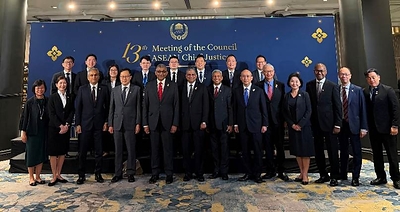
SINGAPORE, Aug. 31, 2026 /PRNewswire/ -- The Singapore Judiciary, led by The Honourable the Chief Justice Sundaresh Menon, participated in the 15th ASEAN Law Association (ALA) General Assembly, 47th ALA Governing Council Meeting and 13th Council of ASEAN Chief Justices (CACJ) Meeting from 21 to 23 July 2026 in Bangkok, Thailand.
At the 47th ALA Governing Council Meeting, Justice Lee Seiu Kin presented the findings of the Crossroads 2.0 Working Group, which identified priority areas for harmonisation in commercial and trade laws, cross-border insolvency, alternative dispute resolution, specialist practice and emerging areas such as the digital economy, artificial intelligence and climate. Justice S Mohan gave an update on the Virtual Training Marketplace, a web portal that matches young lawyers with cross-border training and attachment opportunities across ASEAN member countries. It now has 24 participating firms and facilitated its first successful placement in the past year.
At the 13th CACJ Meeting, all 11 ASEAN jurisdictions discussed initiatives spanning judicial education, cross-border cooperation, technology and emerging legal issues. Key developments included the publication of the first volume of the Memorandum of Guidance on Enforcement of Money Judgments within ASEAN and a Simplified Protocol on Verification Procedure to Authenticate Court Orders within ASEAN, as well as the adoption of a Roadmap to promote the use of Therapeutic Justice and Therapeutic Justice-related practices in ASEAN. The CACJ also continued its work to revise the Governance Framework on the Use of AI for ASEAN Judiciaries. At the close of the Meeting, the CACJ recorded its deep appreciation to Chief Justice Menon for his longstanding contributions to the CACJ.
Singapore judges also contributed to several meetings held on the sidelines of the ALA and CACJ sessions. At the 4th Standing Meeting of ASEAN Insolvency Judges, participants discussed the implementation of the Model Framework for Communication and Cooperation between ASEAN Courts in Cross-Border Insolvency Proceedings and agreed on a scenario-based pilot project on judicial assistance in foreign insolvency proceedings. At the ASEAN Law Conference, Justice Aidan Xu spoke at a session on judicial responses to the use of generative AI in court submissions. ASEAN insolvency and intellectual property judges also met practitioners to exchange views on cross-border restructuring and the enforcement of intellectual property rights.
The meetings underscored the Singapore Judiciary's continued role in advancing ASEAN's efforts to deepen judicial cooperation, strengthen cross-border frameworks and develop future-ready justice systems.
 View original content to download multimedia:https://www.prnewswire.co.uk/news-releases/singapore-judiciary-strengthens-judicial-and-legal-cooperation-within-asean-in-bangkok-meetings-302864793.html

Bayern stellt seine Heimatpolitik auf ein neues Fundament: Mit der weiterentwickelten „Heimatstrategie 2033“ will der Freistaat seine regionalen Strukturen stärken, gesellschaftlichen Zusammenhalt sichern und dabei vor allem den bayerisch-tschechischen Grenzraum stärker in den Blick nehmen. Finanz- und Heimatminister Albert Füracker (CSU) sieht darin eine Fortschreibung der 2014 gestarteten Heimatstrategie, die nun angesichts neuer Herausforderungen angepasst und ausgebaut werden soll. In Nürnberg präsentierte er dazu ein umfangreiches Maßnahmenpaket, das sowohl Kommunen als auch engagierte Bürgerinnen und Bürger gezielt einbinden soll.
Füracker verweist darauf, dass sich in der Grenzregion zu Tschechien bereits viel getan habe, aber weiterhin erhebliches Potenzial schlummere. Dieses wolle man „gemeinsam mit den Menschen“ besser nutzen. Bayerns Erfolgsmodell beruhe auf wirtschaftlicher Leistungsfähigkeit, Innovationskraft und starken Regionen, aber ebenso auf sozialem Zusammenhalt, gelebten Traditionen und einem starken Ehrenamt, so der Minister. Ziel sei es, das besondere Lebensgefühl im Freistaat – in Stadt und Land – langfristig zu sichern und zugleich die Widerstandskraft der Regionen zu erhöhen.
Einen Schwerpunkt der „Heimatstrategie 2033“ legt die Staatsregierung auf Personen, die sich vor Ort in besonderer Weise engagieren. Bereits im Juni ist das Forschungsvorhaben „Heimat-Kümmerer“ gemeinsam mit der Technischen Hochschule Nürnberg angelaufen. Es soll Schlüsselpersonen identifizieren, unterstützen und vernetzen, die ihre Heimat aktiv mitgestalten. Ergänzend ist für den Herbst 2026 eine Bürgerumfrage zum Thema „Werte“ vorgesehen sowie ein „Heimat-Newsletter“, über den Informationen gebündelt und der Austausch mit der Bevölkerung ausgebaut werden sollen.
Parallel dazu sollen die Kommunen finanziell und strukturell gestärkt werden, da sie nach Fürackers Worten der zentrale Ort des Lebens und Zusammenhalts sind. Die bisherige Bilanz der seit 2014 laufenden Strategie – darunter Behördenverlagerungen, Investitionen in den Breitbandausbau oder Initiativen wie ein Dialektpreis – wertet der Minister als Beleg dafür, dass Heimatpolitik konkrete Auswirkungen auf Infrastruktur und Identität haben kann. Mit der Fortschreibung bis 2033 will die Staatsregierung diese Linie fortsetzen, bewährte Maßnahmen weiterführen und neue Initiativen starten, um Bayern als attraktiven und zukunftsfähigen Lebensraum zu positionieren.