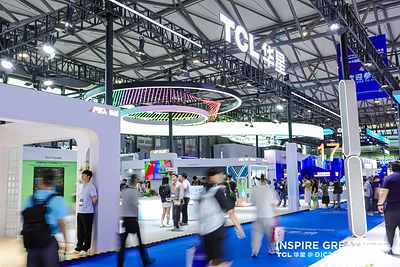
SHANGHAI, Aug. 31, 2026 /PRNewswire/ -- TCL CSOT began its exhibition at the Display Innovation China Expo 2026 (DIC EXPO 2026) in Shanghai. Under the theme "Empowering Diverse Applications, Elevating Display Experiences," the exhibition presents TCL CSOT's cutting-edge display technologies spanning multiple technology pathways underpinned by the company's global leadership in display innovation.
AI-Powered Innovation Drives the Next Generation of Display Technologies
Driven by advances in connectivity, the display industry is moving from standalone screens to connected displays and ultimately toward an era in which "everything becomes a display." At the same time, consumers are looking beyond individual specifications such as resolution and refresh rate to assess the overall display experience, including image quality, visual health, sustainability, and form factor.
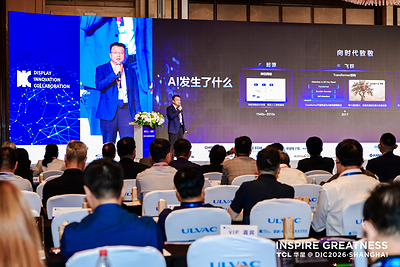
In response to this trend, Bin Zhao, VP of TCL CSOT, GM of R&D Platform of TCL CSOT, stated at DIC EXPO 2026: "Through APEX, our advanced display technology brand, we are advancing innovation across four key areas—display experience, visual health, product sustainability, and boundless possibilities for the future. As the AI era unfolds, we are leveraging our latest proprietary AI model, X-Intelligence, to drive innovation in display R&D. By continuing to improve integration between display technology and AI capabilities, TCL CSOT is leading the next wave of display innovation."
Acceleration of IJP OLED Commercialization Set to Drive Adoption and Production Capacity
In his keynote speech titled "Progress and Trends of IJP OLED Technology," Ming-Jong Jou, Chief of Technology Planning Center, R&D Platform of TCL CSOT, noted: "The market value of the global display industry is projected to grow from $123 billion in 2022 to $156 billion in 2030. Meanwhile, IJP OLED represents an important, high-growth technology pathway for large-scale adoption of medium-sized OLED displays thanks to its high material utilization, lower equipment investment, and low carbon emissions."
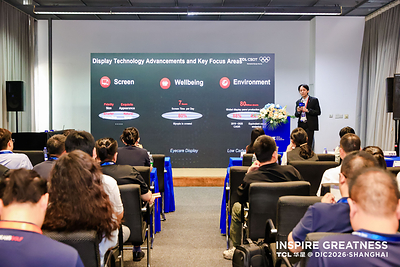
Following extensive sustained investment, TCL CSOT has already brought IJP OLED to mass production in the professional display sector. Looking ahead to consumer applications, Jou said: "We will continue to expand our product portfolio and improve product reliability and production yields, while accelerating joint product development and commercialization with customers. We are currently working with several leading device brands to validate a range of consumer IJP OLED products for laptops and monitors."
Advanced Display Innovations Expand the Boundaries of Display Applications
During DIC EXPO 2026, TCL CSOT's technological expertise in cutting-edge display technologies was on full show with a broad lineup of products in areas including IJP OLED, FMM OLED, visual health, sustainable technologies, and automotive applications.
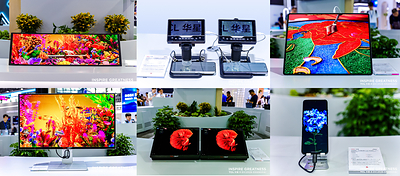
In the OLED category, TCL CSOT showcased the World's First Foldable & Portable IJP OLED Monitor Display (28"). When folded, it measures 16 inches, offering portability comparable to that of a conventional laptop. When unfolded, the 28-inch ultra-wide display delivers an immersive large-screen viewing experience. The IJP OLED Oxide Internal Compensation High Resolution and Refresh Rate Monitor Display (27") features advanced IJP OLED technology with an Oxide backplane and an internal compensation circuit, enabling real-time compensation for improved display uniformity. The World's First Super Pixel High Clarity OLED Mobile Display (6.9") features TCL CSOT's self-developed Super Pixel subpixel multiplication technology, achieving an ultra-high pixel density of 420 PPI and a resolution of 2608 × 1200, while rendering tiny text and complex textures with paper-like print clarity and sharpness. The World's Lowest-power Consumption PLP OLED Tablet Display (13.2") reduces EL power consumption by 30% through the development of high-transmittance color filter materials and the integration of a next-generation panel design. The World's First Mass-Produced Tandem LTPO Foldable OLED Notebook Display (18"), currently the world's largest Tandem notebook display, incorporates LTPO adaptive-refresh-rate technology to deliver precise, professional-grade color performance. The World's First Pure Surface Foldable OLED Mobile Display (6.9") features an industry-first bezel-less structure that seamlessly integrates the display with the device body, creating a more unified appearance.
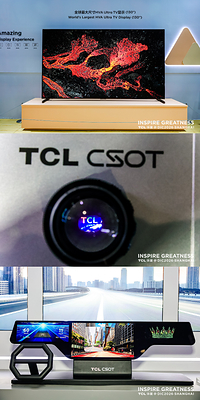
In addition, the World's Largest HVA Ultra TV Display (130") pushes the boundaries of conventional LCD sizes, setting a new benchmark for large-screen design with an ultra-slim 29.8 mm profile. The World's Highest-Res Single-Chip Multi-Color Si-Micro LED Display (0.28") achieves a brightness of over 500,000 nits and offers high pixel density, a wide field of view, and low power consumption, making it ideally suited for high-end AR/VR near-eye display applications. The Driving Safety Triple Automotive Display (12.3" + 15.6" + 12.3") brings together clear visibility of the surrounding environment, intuitive status information, and distraction-reduction features to create a safer and more comfortable driving experience.
Through these technologies, TCL CSOT continues to deliver value by transforming visual experiences and supplying device and display brands with the underlying technologies needed to meet evolving user expectations. Through its advanced display technology brand, APEX, TCL CSOT is working to address image quality, energy efficiency, form factor innovation, visual health and sustainability, using IJP OLED, Super Pixel, ultra-high-mobility oxide technology, silicon-based Micro LED and multi-scenario display solutions. At DIC EXPO 2026 and beyond, the company will continue to work with partners across the display supply chain to move these technologies from demonstration to production and ultimately into the products people use every day.

 View original content to download multimedia:https://www.prnewswire.co.uk/news-releases/tcl-csot-showcases-new-innovations-and-insights-into-the-future-of-displays-at-dic-expo-2026-302864827.html

Silicon Saxony schärft sein Profil als europäischer Technologiestandort – und setzt dabei zunehmend auf hochspezialisierte Anwendungen. Mit dem Zukunftscluster SEMECO (Secure Medical Microsystems and Communications) startet in Dresden die zweite Förderphase für medizinische Halbleiter, während die sächsische Halbleiter- und Softwarebranche trotz schwacher Konjunktur weiter Beschäftigung aufbaut. Branchenangaben zufolge ist die Zahl der Jobs in diesem Ökosystem binnen eines Jahres um 1.500 auf rund 82.500 zum Stichtag 30. September 2025 gestiegen, ein Plus von knapp zwei Prozent gegenüber dem Vorjahr.
SEMECO entwickelt medizinische Halbleiter als Schlüsseltechnologie für sichere, vernetzte und intelligente Medizintechnik. Für die kommenden drei Jahre erhält der Cluster im Rahmen der Clusters4Future-Initiative des Bundesministeriums für Bildung und Forschung (BMBF) bis zu 15 Millionen Euro Fördermittel. Der Freistaat Sachsen begleitet das Bündnis seit Beginn und unterstützt zusätzliche regionale Forschungs- und Entwicklungsprojekte über die EFRE-Technologieförderung 2021 bis 2027. Seine aktuellen Entwicklungen präsentiert SEMECO auf den Silicon Saxony Days, die vom 15. bis 17. Juni 2026 in Dresden stattfinden sollen.
In der zweiten Förderphase richtet SEMECO den Fokus stärker auf standardisierbare medizinische Halbleiterplattformen und deren Transfer in industrielle und klinische Anwendungen. Die spezialisierten Mikrosysteme bündeln Sensorik, Datenverarbeitung, sichere Kommunikation und KI-gestützte Funktionen, zugeschnitten auf Anforderungen der Medizintechnik. Auf Basis eines modularen Plattformansatzes entstehen kombinierbare Halbleiter-, Elektronik- und Softwarekomponenten, die sich sicher integrieren und schrittweise weiterentwickeln lassen. KI-gestützte Methoden sollen zudem Zertifizierung und Zulassung unterstützen und damit den Technologietransfer in die medizinische Praxis beschleunigen – von tragbaren Ultraschallgeräten und intelligenten Vitaldatensensoren bis zu Kommunikationsimplantaten für Menschen mit eingeschränktem Hör- und Sprachvermögen.
Parallel dazu sieht der Branchenverband Silicon Saxony den gesamten Standort vor einer neuen Wachstumsphase. Das jüngste Beschäftigungsplus verteilt sich nach Verbandsangaben nahezu gleichmäßig auf Halbleiterindustrie und Softwarebranche. Die Investitionen der vergangenen Jahre entfalteten zunehmend Wirkung, sagte Frank Schönefeld, Vorsitzender des Präsidiums von Silicon Saxony. Vor dem Hintergrund der gesamtwirtschaftlich schwachen Lage unterstreiche die Entwicklung die langfristige Attraktivität des Standorts. Entlang der gesamten Wertschöpfungskette – von großen Fabrikprojekten bis zu mittelständischen Zulieferern für Reinraum- und Fabrikinfrastruktur, Spezialgase, Chemikalienversorgung und Messtechnik – rechnet der Cluster mit zusätzlichen Impulsen durch Künstliche Intelligenz, Digitalisierung und technologische Souveränität. Die Prognose von mehr als 100.000 Beschäftigten bis zum Ende des Jahrzehnts bleibt aus Sicht des Verbands unverändert bestehen.