HONG KONG, Aug. 28, 2026 /PRNewswire/ -- On August 28, Unisound (09678.HK) announced its interim results for the six months ended June 30, 2026.
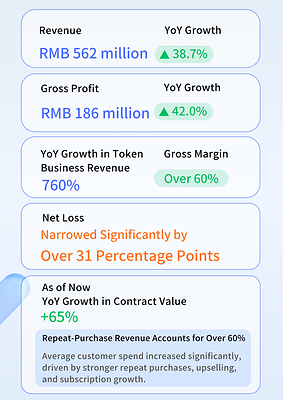
The results show that the company generated revenue of RMB 562 million in the first half of 2026, up 38.7% year over year, with commercialization accelerating across the board. Token business revenue increased by approximately 760% YoY, with a gross margin of over 60%, marking Unisound's entry into a phase of accelerated large-model commercialization as it moves from technological leadership toward value leadership.
Strategic Focus on Three Core Segments, Valuation Framework Shifts Toward a Platform Model
In the first half of 2026, Unisound sharpened its strategic focus on three core segments: Enterprise AI Services, Token Business, and Edge AI. Under the new structure, the company is moving beyond the label of a traditional AI project delivery provider and transforming comprehensively into an AI platform company. The value created by AI is no longer diluted by traditional businesses, fundamentally reshaping the company's valuation framework.
All three core segments delivered solid growth:
Enterprise AI Services: Comprising agent applications, agent platforms, and industry solutions, the segment generated RMB 478 million in revenue, up 35.7% YoY, further consolidating the company's industry-leading position.
Token Business: Revenue reached nearly RMB 30 million, with second-quarter revenue increasing by more than 500% quarter over quarter, making it a new growth engine for the company.
Edge AI: Revenue reached RMB 53.8 million, up 9.2% YoY, while overseas chip shipments increased 50% YoY, demonstrating strong growth resilience.
In terms of operating quality, revenue from repeat purchases accounted for more than 60% in the first half of the year, while average customer spend increased significantly. Repeat purchases and upselling from existing customers provided further support for revenue growth. During the reporting period, administrative expenses fell sharply by 37.8%, with all savings redirected to R&D. The net loss margin narrowed by more than 31 percentage points YoY, while overall gross margin remained stable with a modest increase. As of now, total contract value in 2026 has increased 65% YoY, the order backlog has exceeded RMB 1.5 billion, and cash reserves are approaching RMB 1.0 billion, making the path to profitability increasingly clear.
Architecture Upgrade Drives Platform Transformation, U2 Enters the Global Top Tier
During the reporting period, Unisound continued to enhance its three-layer architecture of "Foundation Capability Layer - Intelligent Construction Layer - Value Operation Layer." Its agent platform, UniAgentOS, has accumulated 1,773 agent instances, with a single module reused up to 119 times. Project implementation costs as a share of total costs fell from 21% in the same period last year to 17%. The revenue model has expanded beyond one-off project delivery to include platform subscriptions, usage-based calls, and ongoing operations, further strengthening revenue continuity.
On the technology front, Unisound has continued to expand the U-Model family around U2, driving ongoing breakthroughs in general-purpose foundation models, industry-specific models, and multimodal capabilities. Across the global LLM landscape, U2 has entered the top tier in multiple challenging benchmarks, spanning long-context understanding (AA-LCR), knowledge reasoning (GPQA Diamond), instruction following (IFBench), agent execution (SWE-bench Verified), and complex tasks (WildClawBench). Its overall performance ranks among the top 25 on LLM Stats and eighth among global model providers.
Going forward, Unisound will continue to pursue its "strong foundation models, deep applications" strategy, with a greater focus on post-training. The company will continue iterating U2 as well as models for the three healthcare domains, speech, and document intelligence. Leveraging its three-layer architecture, Unisound will further increase the reuse rate of agent modules and expand into more industries and regions. In a safe, compliant, and controllable manner, it will advance intelligence to greater heights and for the greater good, creating long-term value for society.
 View original content to download multimedia:https://www.prnewswire.co.uk/news-releases/unisound-2026-interim-results-revenue-up-38-7-yoy-token-business-surges-760-large-model-commercialization-accelerates-across-the-board-302862674.html

Die Zahl der Demenzerkrankungen in Deutschland könnte bis 2060 deutlich ansteigen und das Versorgungssystem spürbar unter Druck setzen. Nach neuen Prognosen des Wissenschaftlichen Instituts der AOK (WIdO) dürfte die Zahl der Betroffenen bei weiter steigender Lebenserwartung von derzeit rund 1,3 Millionen auf bis zu 2,1 Millionen zunehmen. Grundlage der Berechnungen ist ein kleinräumiges Prognoseverfahren, das das Institut gemeinsam mit den Universitäten Trier, Rostock und Köln entwickelt hat.
Die Analyse reicht hinunter bis auf die Ebene von 400 Kreisen und kreisfreien Städten und macht deutliche regionale Unterschiede sichtbar. Bereits 2020 lag der Anteil der Demenzkranken zwischen 1,0 Prozent in Tübingen und 2,6 Prozent in der brandenburgischen Prignitz. Für das Jahr 2060 erwarten die Forscher eine Spanne von 1,7 Prozent Demenzkranken in München bis zu 6,2 Prozent im Landkreis Elbe-Elster in Brandenburg. Besonders betroffen sind damit vor allem ländliche Regionen im Osten, die überdurchschnittlich altern.
Parallel zur wachsenden Zahl von Demenzfällen schrumpft der Pool potenzieller Pflege- und Betreuungspersonen im Erwerbsalter. Laut Studie kamen im Jahr 2020 rechnerisch noch 38 Menschen im erwerbsfähigen Alter auf einen Demenzfall. Bis 2060 dürfte dieses Verhältnis auf 21 Erwerbspersonen pro Fall sinken. Damit würden deutlich mehr Erkrankte von einer deutlich kleineren Zahl potenziell Erwerbstätiger versorgt werden müssen – mit entsprechenden Konsequenzen für Pflegeinfrastruktur, Kommunen und Sozialversicherungen.
Die Autoren der Studie betonen zugleich, dass der prognostizierte Anstieg nicht zwangsläufig ist. Nach heutigem wissenschaftlichem Stand lassen sich Demenzrisiken durch Prävention spürbar senken. Eine konsequentere Behandlung von Bluthochdruck und Diabetes, der Verzicht auf Rauchen oder ein höheres Bildungsniveau könnten dazu beitragen, etwa die Hälfte der Neuerkrankungen zu vermeiden. In einem solchen Szenario würde sich die Zahl der Demenzfälle im Jahr 2060 nicht weiter erhöhen, sondern sich auf einem Niveau zwischen 1,3 und 1,5 Millionen stabilisieren. Die Spannbreite der Projektionen zeigt damit, wie stark der künftige Versorgungsdruck von heute eingeleiteten Präventionsstrategien abhängen dürfte.